
CONFERENCE POLICIES AND REWIEW PROCESS
- ELTICOM will not accept any paper which, at the time of submission, is under review, is accepted for publication, or has already been published in another conference or a journal. Authors are also expected not to submit their papers elsewhere during the ELTICOM 2026 reviewing period.
- All submitted articles should report original, previously unpublished research results, experimental or theoretical. Articles submitted to the conference should meet these criteria and must not be under consideration for publication elsewhere. We firmly believe that ethical conduct is the most essential virtual of any academic. Hence any act of plagiarism is a totally unacceptable academic misconduct and cannot be tolerated. If an author is found to commit an act of plagiarism, the following acts of sanction will be taken:
- Reject the submitted article or delete the article from the final publications.
- Report the authors violation to his/her supervisor(s) and affiliated institution(s).
- Report the authors violation to the appropriate overseeing office of academic ethics and research funding agency.
- Reserve the right to publish the authors name(s), the title of the article, the name(s) of the affiliated institution and the details of misconduct, etc. of the plagiarist.
- All submissions will be checked for plagiarism.
- All submitted articles will go through double blind-review process. Therefore, author names and contact information must be omitted from the submission.
- To be included in the conference proceedings, at least one author of the submitted paper must be registered and present their paper in the conference.
PUBLICATION
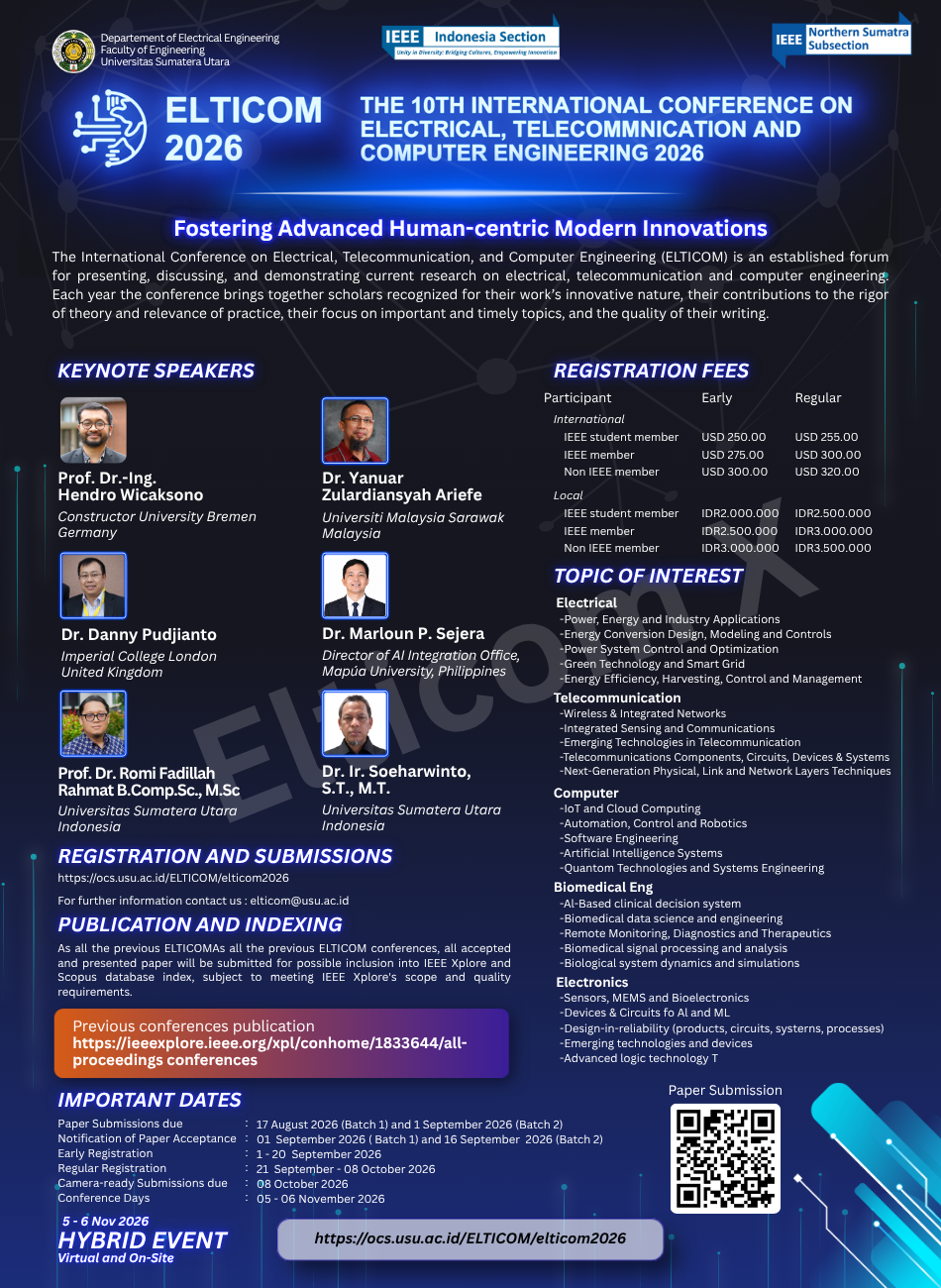
All accepted accepted and presented paper will be submitted for possible inclusion into IEEE Xplore and Scopus database index, subject to meeting IEEE Xplore's scope and quality requirements.
Previous confrences publication can be found here: https://ieeexplore.ieee.org/xpl/conhome/1833644/all-proceedings